Avatar Realms Collide Tier List (Player’s Guide): Who to Build, Who to Skip, and How to Actually Win With Them
If you’re here for an avatar realms collide tier list, you’re probably in one of these moods:
You just pulled someone shiny and you’re asking, “Is this cracked… or is this bait?”
You’re getting smacked in PvP and you want a lineup that doesn’t fold like wet paper.
You’re F2P (or low spender) and you can’t afford to “try everything” because resources in games like this are basically emotional damage in currency form.
So yeah—tier lists matter. Not because they magically play the game for you, but because they stop you from wasting weeks upgrading a hero who peaks at “pretty okay if the moon is full and the map is tiny.”
Also: this game lives and dies by team synergy. A “mid” hero can feel godlike if your comp makes sense, and an S-tier hero can look embarrassing if you stick them in the wrong role or starve them of support. That’s why this guide isn’t just “S good, C bad.” I’m going to talk about why each hero is placed where they are, what they’re good at, what they hate playing into, and how to build teams that don’t auto-lose at the loading screen.
How often does the meta change? Pretty often, depending on balance updates, new hero releases, and whatever the current event mode incentivizes. So treat this list as a living snapshot, not a religious text. The goal is to give you a decision framework you can reuse even when the rankings shuffle.
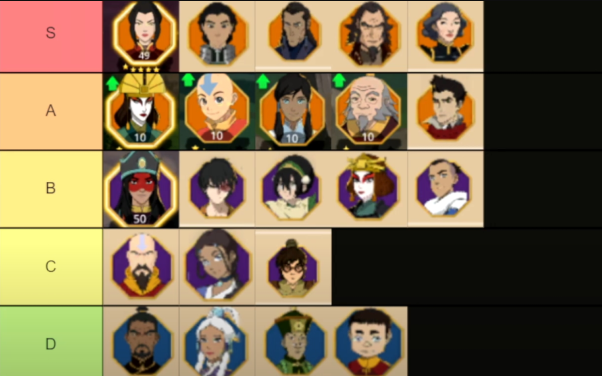
I. What This Tier List Is Actually Measuring
Before we slap labels on heroes, here’s the “behind the scenes” logic. A hero in a strategy game like Avatar: Realms Collide isn’t just “strong” or “weak.” They’re strong under specific conditions:
The four big questions I use when ranking heroes
Do they win fights that matter?
Not “they farm easy NPCs faster.” I mean: can they swing PvP trades, protect your city, win key boss phases, or enable your alliance push?How flexible are they across modes?
Some heroes are monsters in siege but kind of whatever in boss fights. Flexibility is value—especially early.How hard are they to build?
A hero that needs perfect stars, specific talents, and niche teammates might still be top-tier, but they’ll be less useful to the average player than a hero that pops off with basic investment.Do they scale into late game?
Early-game bullies can fall off hard. Some supports age like fine wine because utility doesn’t get power-crept as easily as raw damage.
That’s why you’ll see me talk about “worth building early” vs “worth building forever.” Those are different.
II. Tier System Explained (S / A / B / C)
S-Tier (Meta-defining / Must-have feel)
These heroes either:
carry fights by themselves or
enable your whole roster to play above their weight class.
If you’re serious about competing, S-tier heroes usually become long-term staples.
A-Tier (Strong alternatives / Excellent specialists)
These heroes are:
very strong in the right teams or modes,
sometimes slightly less universal than S-tier,
often easier to obtain/build (depending on the game’s banner system).
A-tier is where a lot of smart F2P players live.
B-Tier (Solid / Beginner-friendly / Role players)
B-tier heroes:
can absolutely win,
usually need better positioning, better teammates, or better timing,
often get outscaled by higher tiers in straight-up equal-investment matchups.
But they’re still useful—especially if they’re accessible.
C-Tier (Situational / Early-only / Outclassed)
C-tier heroes:
might be okay in very specific situations,
usually get replaced once your roster expands,
tend to be resource traps if you over-invest.
That doesn’t mean “unplayable.” It means “don’t build this first unless you love them.”
III. S-Tier Heroes (Legendary and Must-Have Characters)
This is the part everyone scrolls for, so let’s just go in.
A. Uncle Iroh — Defensive Support King
If you’ve played any team strategy game ever, you already know this archetype: the hero that doesn’t always top damage charts, but somehow your whole team becomes impossible to kill when he’s on the field.
Why he’s S-tier:
Team protection is always relevant. It doesn’t matter if the meta is burst, sustain, siege, or bossing—damage mitigation and survivability scale forever.
He’s the kind of hero that turns “barely losing” fights into wins because your frontline doesn’t collapse instantly.
Defensive supports are also disgusting in PvP because humans panic when their burst doesn’t finish the job.
Where Iroh shines most:
Garrison defense (your city, alliance structures, key objectives)
PvP trades where fights are decided by who runs out of sustain first
Boss battles that punish sloppy healing or weak frontline
How to use him without griefing yourself:
Don’t treat him like a DPS. If you build him for damage, you’re basically buying a luxury sports car and using it as a bookshelf.
Put him with heroes that want time to ramp (your heavy hitters, your “late fight” monsters).
Team pairing ideas:
Iroh + Kyoshi = your frontline becomes a problem nobody wants to solve.
Iroh + Korra = stable, flexible team that survives long enough to actually leverage Korra’s versatility.
B. Kyoshi — The “I Do Everything” Monster
Kyoshi is the hero I recommend when someone says, “I don’t know what I’m doing, but I want to win.”
Why she’s S-tier:
She’s versatile in the truest sense: offense, defense, tempo control—she does enough of everything to fit almost any comp.
She’s the kind of hero that performs even when the rest of your team is imperfect.
Great “anchor pick” when you’re unsure what mode you’ll be focusing this week.
Best uses:
General PvE progression (story, farming, mid-tier bosses)
PvP when you want consistent performance rather than coin-flip burst
Mixed-element comps where you don’t want to overcommit to one nation synergy
How to play her smart:
Let Kyoshi be your “stable core” and build specialists around her.
If your comp is already tanky, you can lean Kyoshi into damage.
If your comp is fragile, lean into durability.
That flexibility is literally why she’s S-tier.
C. Korra — Elemental Versatility and Buff Utility
Korra is one of those heroes where the more you play, the more you realize she’s not “just strong”—she’s strategically valuable.
Why she’s S-tier:
She offers multi-role value: damage, buffs, adaptability.
She doesn’t lock you into one type of team. If your roster is uneven, Korra smooths it out.
She’s especially good in content that shifts between waves, objectives, and mid-fight repositioning.
Where Korra is at her best:
Mode rotations where you need one hero to be useful everywhere
Alliance content where you can’t always rely on perfect matchups
Long fights where buffs and sustained impact matter
Common mistake:
People try to force Korra into “pure DPS carry.” She can do damage, sure, but her real power is that she makes your whole comp more functional. Treat her like a flexible centerpiece, not a one-button nuke.
D. Bumi — Earthbender Durability + Real Damage
Bumi is that annoying hero who refuses to die and somehow still hits like a truck. In these games, that combo is always a nightmare to deal with.
Why he’s S-tier:
Durability keeps him relevant in every meta.
He’s strong in modes where frontline presence decides space control (siege, choke points, objective fights).
He pairs incredibly well with supports because he benefits more from sustain than squishy burst heroes do.
Best modes:
Siege and territory fights
Garrison defense
PvE wave content where having a stable frontline keeps runs consistent
How to build around Bumi:
If your team already has a tank, Bumi can act as “bruiser DPS.”
If your team lacks a tank, Bumi becomes your “do-not-pass” wall.
E. Aang — Balanced Avatar With High Ceiling
Aang is balanced in a way that feels “fair”… until you realize fair heroes are often the scariest in skilled hands.
Why Aang is S-tier:
He’s reliable in almost every situation.
His offensive + support blend makes him a great “glue hero.”
He scales with player decision-making: positioning, timing, target selection.
Where Aang shines:
Mixed teams where you need someone to smooth out weaknesses
PvP when you want a hero that doesn’t rely on cheesy conditions
General progression as a long-term investment
Aang is basically the hero you build when you want to stop rebuilding your roster every two weeks.
IV. A-Tier Heroes (Strong Alternatives and Specialists)
A-tier is full of heroes that can feel S-tier in the right setups.
A. Asami Sato — Tactical Utility and Economy Value
Asami is the classic “non-bender who wins with brains.”
Why she’s A-tier:
Provides utility that impacts more than just combat—resource flow, tempo, efficiency.
Great for players who like optimizing and playing the long game.
Often a sneaky strong pick in alliance environments because “supporting the machine” matters.
She’s not always the flashiest in fights, but she can make your whole account progress faster. That’s real power.
B. Azula — Siege Queen and Burst Pressure
Azula is the “end the fight now” hero.
Why she’s A-tier:
Big burst, strong aggression, punishes mistakes.
Great in modes where deleting a key target wins the entire exchange.
Strong in siege environments where pressure matters.
Why not S-tier?
Because she’s often more matchup-dependent than the Avatars and top supports. If she can’t find clean targets (or gets controlled), she can feel worse fast.
C. Lin Beifong — Defensive Specialist / Garrison MVP
Lin is the type of hero you build because you’re tired of getting bullied.
Strengths:
Garrison defense value is huge (especially in strategy games where losing a defense costs you time and resources).
Excellent for holding positions and making enemy pushes inefficient.
Lin is rarely “bad,” but she’s not always universal outside her best jobs—which is why she sits A-tier.
D. Sokka — Tactical Buff Support
Sokka is not the hero you pick to top damage charts. He’s the hero you pick because your team becomes smarter just by existing.
Strengths:
Buffs, utility, teamwide value
Great for comps that rely on timing and coordinated bursts
He’s A-tier because in the right team, he feels unfair—just not always plug-and-play.
E. Tenzin — Versatile Airbending Utility
Tenzin is usually the “clean, consistent” pick.
Strengths:
Useful in both offensive and supportive roles
Great in content where movement, tempo, and flexibility matter
He’s not the strongest at one thing, but he’s good at many things. That’s A-tier energy.
F. Toph — Defensive Position Tank
Toph is a rock. Literally.
Strengths:
Defensive holding
Stable frontline presence
Why A-tier?
Because while she’s excellent defensively, some S-tier tanks/bruisers offer similar durability plus more universal offensive pressure. Still, if you need a tank that does tank things, Toph is a safe build.
V. B-Tier Heroes (Balanced and Beginner-Friendly)
B-tier heroes are where you can win a lot—especially if you understand what they’re actually for.
A. Zuko — Early Offense and Leadership
Zuko usually feels best early-to-mid game.
Strengths:
Solid offensive presence
Reliable enough for progression
Weakness:
Often outscaled by higher rarity or more specialized damage dealers later.
Still worth building if he’s one of your first strong pulls.
B. Katara — Healer That Keeps Teams Alive
A good healer is never truly “bad,” especially for newer players.
Strengths:
Sustain = consistency
Helps you clear content above your power level because your team doesn’t collapse
Why not higher tier?
Because top-tier supports often bring healing plus buffs/cleanses/mitigation that scale harder into endgame.
But Katara is the hero that saves your run when you mess up, and that’s priceless early.
C. Unalaq — Debuff and Spirit Utility
Unalaq is a classic “needs the right comp” hero.
Strengths:
Debuffs and control-style contributions
Great when paired with heroes that exploit weakened enemies
If you like tactical play and you’re building around debuffs, Unalaq can feel way better than his tier suggests.
D. Suki — Counterattack / Secondary Tank
Suki is a solid role player.
Strengths:
Useful defensive presence
Can punish enemies who overcommit
She’s rarely the core of a comp, but she’s a great “third piece” when you need stability.
E. Kuvira — Strategic Management Pick
Kuvira is for players who like efficiency and control rather than flashy burst.
Strengths:
Good “account value” in some builds
Can help stabilize your progression
Not always the best for pure combat dominance, but not useless.
VI. C-Tier Heroes (Situational / Early-Game Only)
C-tier doesn’t mean “trash.” It means “don’t dump your best resources here unless you have a reason.”
A. Kuei — Resource Utility More Than Combat
Kuei is often more of a “city/economy” style pick than a battle god.
If you’re trying to push competitive PvP, he’s usually not your priority. If you’re playing a slower, builder-focused approach, he can still contribute.
B. Meelo — Early PvE Helper
Meelo can be fine early because early enemies don’t punish weaknesses as hard. Later on, his value often drops because stronger kits outclass him.
C. Piandao — Precision Specialist
Piandao is one of those heroes that can feel okay if you love his style, but he typically doesn’t bring enough universal value to justify heavy investment compared to higher-tier options.
D. Yue — Minor Healing Utility
Yue can help early if you’re desperate for sustain, but most players replace her once they get stronger supports.
VII. Bender Types and Elemental Roles
This is where a lot of newer players get tricked.
They think: “Fire beats everything because damage.”
Then they get erased by a well-built defensive Earth comp and they learn humility.
Here’s the simple breakdown:
Earthbenders
Usually your tanks/bruisers
Great for holding territory, defending, controlling space
Firebenders
Usually your aggressive DPS/burst
Great for siege pressure and quick fights
Waterbenders
Usually your healers/support
Great for sustain-heavy metas and long PvE encounters
Airbenders
Usually your tempo/mobility/utility
Great for flexible play and comps that win via positioning and control
The real trick: don’t build three heroes that all want the same job.
VIII. Nation Selection and Element Bonuses
Nation choice is basically your account’s “playstyle bias.” Some nations naturally support growth or combat pacing. Guides consistently emphasize that nation bonuses matter for long-term efficiency and early progression planning.
Earth Nation
Think: build faster + gather + Earth synergy
If you like expanding and fortifying, Earth is comfy.
Water Nation
Think: research + healing efficiency + Water synergy
Feels great for players who want smoother progression and stable combat.
Fire Nation
Think: recruitment speed + aggressive growth + Fire synergy
If you want pressure and tempo, Fire is often appealing.
Air Nation
Think: march speed + flexible research + Air synergy
Great for active players who like moving, rotating, and playing the map.
My advice: pick a nation that matches how you actually play, not what sounds coolest. The “best” nation is the one you’ll leverage daily.
IX. Game Modes and Content-Specific Rankings
Here’s the truth: the same hero can be S-tier in one mode and just “fine” in another. Even beginner guides point out mode variety and the need to adapt your approach depending on objectives.
Battle Arena (PvP)
You want burst + control + sustain
S-tier supports become ridiculously valuable here because humans make mistakes and longer fights punish sloppy decisions
Top priorities: Iroh, Kyoshi, Aang, Korra
Shattered Skull / Boss Content (PvE)
Bossing usually rewards:
stable frontline
consistent damage
reliable healing/mitigation
Top priorities: Bumi + Iroh style cores shine here, with flexible Avatars supporting.
Garrison Defense
If you hate logging in to see “your city got cooked,” invest here.
Top priorities: Lin Beifong, Iroh, Bumi, Toph-style defenders
Siege / Territory Control
Siege rewards:
pressure heroes (Azula)
frontline that doesn’t melt (Bumi, Kyoshi)
utility picks that keep pushes organized (Aang/Korra style flexibility)
X. Team Building and Hero Synergy
If you only remember one thing, remember this:
The safest team formula
1 tank/bruiser + 1 main damage + 1 support/utility
You can flex it into:
double DPS + support (aggressive)
double frontline + healer (defensive)
balanced (most consistent for F2P)
Mono-element vs mixed teams
Mono-element can be strong if your nation bonuses and hero roster support it.
Mixed teams are usually easier early because you can plug holes with whatever you pull.
Avatar pairing logic
Avatars tend to be good “comp stabilizers.”
If your roster is messy: run Aang/Korra to glue it together.
If your roster is stacked: run Kyoshi to push advantage.
XI. Beginner Guide and Early Progression
If you’re new, here’s how to not ruin your account.
Best starter priorities
One stable frontline (Bumi / Kyoshi / Toph-type)
One consistent support (Iroh / Katara early)
One damage dealer (Azula / Aang / Korra depending on pulls)
Don’t do this
Don’t level 10 heroes to “kinda usable.”
You’ll end up with 10 weak heroes and no carry.
Do this instead
Build 3–4 heroes hard, then expand once your core team is stable.
XII. Hero Summoning and Acquisition
Most strategy gachas use a “shrine/altar” style system where you pull heroes via scrolls or tickets, and early guides emphasize understanding how you obtain heroes so you don’t waste resources impulsively.
General pull advice (player-to-player)
If you can secure one S-tier cornerstone (Kyoshi / Aang / Korra / Bumi / Iroh), do it.
After that, pull to complete teams, not just to collect.
Rerolling (if you’re that kind of person)
Rerolling is only worth it if:
the game gives enough early pulls to matter
you have patience
you want a long-term advantage
If rerolling stresses you out, skip it. A calm player who plays daily beats a stressed player with a perfect reroll.
XIII. Hero Talents and Skill Development
Talents are where “same hero” becomes “different hero.”
General talent philosophy
Tanks want survivability first, then utility.
DPS want consistency first, then burst.
Supports want uptime: anything that keeps their buffs/heals online.
Common newbie mistake
Putting offensive talents on heroes whose job is to keep your team alive. If your support dies faster but does 3% more damage, that’s not value—that’s comedy.
XIV. Alliance Benefits and Group Synergies
If you’re playing this game solo, you’re basically playing on hard mode.
Alliances usually give you:
buffs
reinforcements
shared territory objectives
events that dump resources into your account
Even casual alliance membership is worth it because the “free stuff” adds up.
XV. Troop Training and Army Composition
Heroes don’t fight alone—troops and formation matter.
Simple army logic
Your frontline hero should be backed by troops that benefit from holding space.
Your DPS hero should be backed by troops that amplify damage windows.
Your support should be protected, because dead supports don’t support.
If you ever wonder why you lose despite higher power, it’s usually one of:
bad targeting
poor troop matchup
frontline collapsing too fast
support dying early
XVI. Frequently Asked Questions
1) Which heroes should beginners prioritize?
If you can: Kyoshi / Aang / Korra / Bumi / Iroh first. If not, build a stable trio: frontline + support + DPS and expand from there.
2) Is Uncle Iroh worth the investment?
Yes—defensive support value scales into late game. He’s the kind of hero you’re happy you built months later.
3) How do I build a balanced team?
Use the formula: frontline + damage + support. Then adjust depending on mode.
4) Which nation is best long term?
The best nation is the one that matches your daily play pattern. Nation bonuses influence efficiency, so pick what you’ll actually use.
XVII. Personal Recommendations and Meta Summary
Here’s my honest “if I had to restart” take:
If you want the safest, most future-proof roster
Kyoshi as your core bruiser
Iroh as your defensive backbone
Aang or Korra as your flexible glue (depending on what you pull)
If you want to play aggressive and bully people
Azula for pressure
a durable frontline (Bumi/Kyoshi)
a support that keeps the push alive (Iroh/Sokka-style utility)
If you’re F2P and you hate wasting resources
Build one team first.
Upgrade heroes that stay useful across modes.
Avoid dumping premium mats into heroes you’ll replace in two weeks.
Final reality check
Tier lists are guidelines, not destiny. If you master a B-tier hero and understand matchups, you’ll beat people who chase S-tier picks but don’t know how to use them. The tier list is just a shortcut to smarter decisions—not a substitute for skill.
So that’s the avatar realms collide tier list the way I’d explain it to a friend: not just who’s “good,” but who’s worth your time, your resources, and your long-term planning.
If you want the simplest takeaway:
S-tier: Iroh, Kyoshi, Korra, Bumi, Aang
A-tier: Asami, Azula, Lin, Sokka, Tenzin, Toph
B-tier: Zuko, Katara, Unalaq, Suki, Kuvira
C-tier: Kuei, Meelo, Piandao, Yue
And the bigger takeaway:
Build teams, not individual heroes.
Pick a nation that matches your playstyle.
Invest like you’re protecting your future self from resource regret.
If you want, I can also write a “best teams by mode” add-on (Arena / Siege / Bossing / Garrison) using only the heroes you personally own—just paste your roster and I’ll build comps around it.