DC Worlds Collide Tier List (2026 Meta Guide) — The Player’s “Who Do I Build?” Cheat Sheet
If you’re here for a dc worlds collide tier list, you’re probably in the exact same situation I was in after my first few days: you’ve got a growing roster, your upgrade resources feel like they evaporate the second you tap “Level Up,” and every mode is basically asking, “Cool… but do you have the right five heroes?”
DC Worlds Collide is a squad-based strategy RPG where you recruit DC heroes/villains, build a 5-unit team, and win fights by mixing roles (damage, tank, support/control) and stacking synergy systems like affinities/linked bonuses. The whole vibe is: build a team that works together, not just five strong-looking cards.
What this tier list is (and isn’t)
It is: a practical ranking for campaign progress, bossing, and competitive modes—based on who gives you value even with average gear, average RNG, and a normal human wallet.
It isn’t: “the only correct way to play.” Some lower-tier characters are absolute monsters in the right setup, and some top-tier units feel mid if you build them wrong or force them into the wrong job.
How often the meta shifts
This kind of game changes fast. New characters drop, balance tweaks happen, and suddenly the community goes from “this unit is broken” to “why is this unit tickling enemies?” overnight. Even the public version history shows regular updates/maintenance.
So: use this tier list as a compass, and keep your eyes open when new patches land.
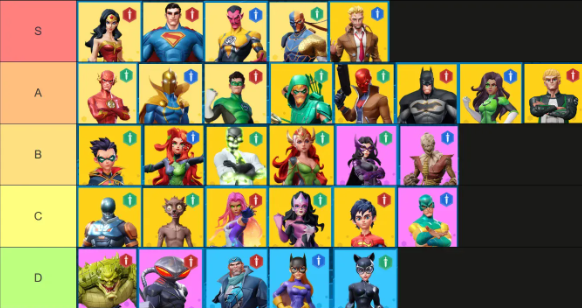
I. DC Worlds Collide Tier List Overview
I’m going to use a simple tier structure that matches how most players talk about the meta:
S+ Tier: Meta-defining. If you have them, your account is simply easier to progress.
S Tier: Elite. Either slightly more team-dependent, or a tiny bit less universal than S+.
A Tier: Strong and flexible. Great if you’re missing S+/S, or need specific roles.
B Tier: Solid but situational. Can clear content, but needs better setup or matchups.
C Tier: Mostly early-game fillers or niche picks you build only for specific reasons.
And because this game is synergy-heavy, I’m ranking characters by:
Damage output (burst and/or consistent)
Survivability (self-sustain, mitigation, safety)
Team utility (buffs, shields, heals, control, debuffs)
Synergy potential (how well they plug into common comps)
Value per resource (how good they feel without needing perfect investment)
Also: roles matter. A cracked DPS with no tank/support behind them is basically just a highlight reel waiting to get deleted.
II. Core Mechanics That Matter (Why Your “Strong Team” Still Loses)
Before we talk characters, you need to understand why two players can run the “same tier list team” and get wildly different results.
1) Affinities vs Team Synergies (Roster bonus vs in-fight bonus)
One of the biggest “wait, what?” systems is that some bonuses activate just by owning linked characters, while others only activate when linked characters are in your squad.
Affinities: passive stat boosts to specific characters based on who you own (even if they aren’t in the current team).
Team Synergies: bonuses that trigger only when certain linked characters are actually on the field together, often scaling with rank.
Practical take:
If you’re a light spender or F2P, affinity bonuses are a sneaky way to power up a carry even if you don’t have the “perfect” five-unit dream team yet.
2) Trait Advantage Triangle (aka the color matchup game)
There’s a simple advantage loop: Tactical (Blue) → Mighty (Red) → Agile (Green) → Tactical (Blue).
If you’ve ever felt like your team “randomly” hits harder or gets smashed, matchup advantage is often the reason.
Practical take:
In tough stages, don’t just slam your highest power team. Sometimes swapping 1–2 units to win color matchups is a bigger upgrade than 10 levels of gear.
3) Positioning and Ultimate Order
Positioning matters—especially who takes the first punches. And being able to set ultimate timing/order is huge because you can line up:
defensive ult → heal → control → burst
instead ofburst → burst → burst → “why did my team die?”
That order wins stages. Skill kits matter, yes, but timing is how you steal wins.
III. The Actual dc worlds collide tier list (2026 Practical Meta)
S+ Tier (Absolute Best / Build-First Characters)
These are the units that feel unfair when they’re on your side—and annoying when they’re on the enemy side.
1) Wonder Woman — S+ (AoE carry + team-wide payoff)
Wonder Woman is the kind of unit that makes your early and mid game feel like you’re playing on “fast forward.” She brings big AoE damage, and she also boosts team output by increasing ally Crit Damage (which scales insanely well as your account grows).
Why she’s S+ in real gameplay
She clears waves faster (campaign value is massive).
AoE damage means fewer “one unit left alive” disasters.
Her kit rewards you for investing—she’s not just an early-game crutch.
How I’d build around her
Give her a frontliner who keeps her alive long enough to press ult twice.
Pair with a support that boosts team tempo or keeps debuffs under control.
If you’re rerolling or picking a “main,” Wonder Woman is the easiest “yes” in the game.
2) Lex Luthor — S+ (Team shields + defensive engine)
Lex is one of those tanks that doesn’t just soak damage—he enables your entire team. Team-wide shields, personal damage reduction, and even ally assist attacks make him feel like the “glue” that keeps your comp from exploding.
Why he’s S+
Shields turn close fights into wins.
Assist mechanics multiply your DPS value without needing more resources.
He stays useful across modes because defense is never “out of meta.”
If you have Lex, your squishy carries suddenly stop feeling squishy.
3) Superman (including “DCU” variants) — S+ (Endgame tank power)
Superman is described as a strong end-game tank with high survivability.
In practice, this usually translates into: you can actually survive the “enemy ult chain” moments that delete lesser tanks.
Why he’s S+
High durability = consistency.
Consistency = fewer retries.
Fewer retries = faster progress = more resources.
If you’re building for hard PvE or long fights, Superman is a cornerstone.
4) Sinestro — S+ (Control/disable specialist)
Control units are often S+ not because they top damage charts, but because they prevent you from losing.
Sinestro is positioned as a signature character in the game’s own promotional framing, which lines up with him being a high-impact control pick.
What makes control S+
Turns enemy “burst windows” into wasted turns.
Buys time for your carry to ramp.
Wins matchups against higher-power teams (especially in PvP).
5) Deathstroke — S+ (Single-target assassin pressure)
Deathstroke is framed as one of the headline “lethal tactics” characters in the official store description, and he typically plays like a premium pick for deleting a priority target before they run away with the fight.
Why he’s S+
High value in bossing and “kill the backline” scenarios.
Makes PvP cleaner: remove threat → win.
6) Doctor Fate — S+ (Magic AoE + utility angle)
Doctor Fate shows up as a key “arcane shields / magic” pillar in the game’s own depiction of team combos.
In practice, Fate-like units tend to be strong because they bring damage while also interacting with buffs/debuffs/defensive layers.
7) Green Lantern (Hal) — S+ (Protection-focused tanking)
Shielding tanks are premium in games where damage spikes can one-tap your backline. Green Lantern is positioned as part of the “impenetrable defense” fantasy in official descriptions.
If your teams struggle with survivability, Lantern-type protection is a straight upgrade.
S Tier (Elite Picks / Slightly Less Universal than S+)
These units win games, but might be a little more comp-dependent, or they shine hardest in specific modes.
Zatanna — S (F2P-friendly support who actually matters)
Zatanna is an “account stabilizer.” She supports, buffs, and brings utility (including interacting with enemy buffs), and she’s called out as an excellent support option.
Why she’s S
Support value scales with your roster.
She fits into almost every team because every team wants sustain/utility.
She makes your “okay DPS” feel like good DPS.
If you don’t have a premium healer/support, Zatanna is how you stop faceplanting in longer fights.
Constantine — S (AoE damage with self-risk, huge payoff)
Constantine is a very common F2P-friendly DPS recommendation because he can deliver AoE damage and has sustain mechanics like lifesteal.
He’s not always “safe,” but he’s efficient.
How to play him
Don’t treat him like an unkillable carry.
Protect him with shields/heals.
Let him do what he does best: melt groups.
The Flash — S (Speed pressure, multi-target threat)
Flash units tend to be about tempo—creating turns, pushing advantage, cleaning up fights. He’s explicitly featured as a core character in the game’s official description and early acquisition framing.
Batman — S (Single-target burst + debuff payoff)
Batman is described as excellent single-target burst and scaling off enemy debuffs.
That makes him way better when paired with tanks/supports who apply debuffs (Armor Break, Weaken, etc.).
Nightwing — S (Durable frontline, block value)
Nightwing is presented as a durable frontline unit with frequent blocks, and he scales especially well with certain synergy partners.
If you don’t have Lex/Superman, Nightwing is a practical “I need someone to stand in front and not instantly fold” solution.
Starfire — S (AoE row pressure)
Row damage is one of those things that feels “fine” until you hit content where the enemy backline is the real boss. Starfire-style AoE pressure is often how you stop supports from taking over fights.
Raven — S (Utility + revive-style safety)
Raven is called out as having revive utility and synergy with debuffed-enemy damage amplification.
That’s basically two things you always want:
“Don’t die”
“Kill faster”
A Tier (Strong and Versatile)
A-tier units are what you build when you’re missing a couple premium pieces, or when you need a specialist.
Green Arrow — A (AoE clearer you can actually obtain)
Green Arrow is described as a high AoE damage unit with crit scaling perks and good accessibility through shops/boxes.
That combination is why he’s a staple in so many accounts: he’s strong and realistically obtainable.
Kid Flash — A (Focused healing / keeping one carry alive)
Kid Flash is framed as more of a single-target healer option.
If your strategy is “one hypercarry does everything,” single-target sustain is sometimes better than spread healing.
Gorilla Grodd — A (Debuff tank utility)
Grodd applies debuffs like Slow/Weaken/Armor Break and is easy to build.
That makes him a great “budget enabler” for Batman and other debuff-scaling attackers.
Superboy — A (AoE consistency / backline pressure)
Superboy is described as consistent AoE and useful for clearing groups/backlines.
He’s not always the flashiest, but he wins by being reliable.
Red Hood — A (Single-target threat + second life)
Red Hood is highlighted as a strong damage dealer with a resurrection mechanic.
Second-life mechanics are incredibly valuable in both PvE and PvP because they punish enemies who commit burst too early.
Bizarro / Two-Face — A (Situational specialists)
These characters usually move up/down depending on patch tuning and synergy availability. If your roster supports their gimmick, they can play above A-tier.
B Tier (Solid Mid-Tier Performers)
B-tier is where you’ll find characters that are absolutely playable—just more sensitive to:
gear quality,
matchup,
team structure,
or investment depth.
This is also where a lot of “I like this character” picks live, and honestly? If you build them smart, you can clear most content.
Examples that commonly land here:
Bane (durable bruiser vibes)
Penguin (hybrid utility)
Martian Manhunter (control tank style)
Cyborg (burst ST)
Supergirl (balanced hybrid)
The Bride / Judomaster (mechanic-specific value)
If you’re building B-tier, your job is to make their strengths show up consistently:
Put burst units behind real protection.
Put DoT units with debuff amplifiers.
Put control units in comps that can capitalize on the control (not just stall forever).
C Tier (Limited Viability / Early-Game Fillers)
C-tier doesn’t mean “unusable.” It means:
they’re often replaced quickly,
they’re more niche,
or they’re too resource-hungry for what they deliver.
Characters like Robin-style stealth burst or Ivy-style poison setups can be perfectly fine—but usually require more specific teams to look good.
If you’re early-game and resources are tight, C-tier is where you don’t want to “accidentally max someone” unless you genuinely love them.
IV. Rarity, Acquisition, and Why “Epic Can Beat Legendary”
Here’s a truth every gacha player learns the hard way:
Rarity isn’t the same thing as usefulness.
Some Epic units show up earlier, get easier duplicates, and reach higher ranks faster.
Some Legendary units are incredible… but feel underwhelming at low rank if their kit wants scaling.
So if you’re F2P or low-spend:
A highly-ranked Epic support can outcarry a low-ranked Legendary damage dealer.
The best investment is often: 1 stable tank + 1 stable support + 1 carry you can actually rank up.
(And yes, this is why Zatanna/Constantine/Green Arrow get recommended so often. )
V. Trait Advantage System (How to Stop Losing “Even With More Power”)
Remember the triangle: Tactical > Mighty > Agile > Tactical.
Practical rules I use:
If I’m stuck, I check enemy colors first.
I swap 1–2 units to gain matchup advantage.
Then I re-try before I waste resources upgrading.
This is the simplest “free power” you’ll ever get.
VI. Tactical Resonance / Team Synergy (The Real Endgame)
At first, you think the game is about levels. Later, you realize it’s about synergy.
Theria’s guide breaks down how team synergies activate only when specific linked characters are deployed together and can scale with rank.
So if you’re trying to build a serious team, don’t just think “who is S+?” Think:
Who has synergy triggers I can realistically complete?
Do I own the linking characters?
Will that synergy boost the whole squad or just one unit?
That’s how you build teams that punch above their power.
VII. Team Building Templates (What I Actually Run When I Want Wins)
1) The “Standard Stable” Team (Best general-purpose formula)
1 Tank (Lex / Superman / Nightwing)
2 DPS (one AoE + one single-target)
2 Support (heals/shields + utility/control)
Theria also suggests a common balanced structure like two damage dealers, one tank, and two support/healers.
This comp clears campaign smoothly and doesn’t auto-lose long fights.
2) The “AoE Farming” Team (Campaign speed / wave modes)
Tank
2–3 AoE DPS
1 support that keeps them alive
This is where Wonder Woman + Green Arrow + Constantine-style teams feel amazing.
3) The “Boss Delete” Team (Single target, survival first)
Strong tank + shield
Single-target assassin (Deathstroke/Batman style)
Support that keeps your carry alive
Optional debuff tank (Grodd style) to amplify damage
VIII. Beginner-Friendly Teams (F2P Path That Doesn’t Feel Miserable)
If you’re starting out and don’t have the full S+ lineup, you can still build a scary account by leaning into accessible performers that scale with time.
Theria lists multiple F2P-friendly picks (like Constantine, Green Arrow, Zatanna, Lex Luthor, Batman, Nightwing, etc.).
My recommended “first real team” goal
Frontline: Nightwing (or any durable tank you own)
DPS: Constantine + Green Arrow
Support: Zatanna
Flex slot: Grodd (debuff), Batman (burst), or another support
It’s not fancy, but it clears, and it teaches you the real game: timing, positioning, synergy.
IX. Investment Priority (How to Not Ruin Your Account)
This is the part nobody wants to hear, but everyone needs:
Build fewer characters than you want to build.
Pick a core group of 5–6 and focus.
My priority order
One real tank (because dying is the slowest form of DPS)
One real support (because sustain = consistency)
One carry DPS (AoE preferred early)
One single-target DPS (bossing / priority kill)
One flex (control/debuff utility)
That’s how you avoid the classic “I leveled 15 characters and now I’m broke” trap.
X. Reroll Strategy (If You’re Doing It)
If you’re rerolling, your goal isn’t “perfect.” Your goal is “account momentum.”
Dream reroll targets
Wonder Woman
Lex Luthor
Superman
Because those three cover: wave clear + survival + stability.
If you hit one of them early, you’re already ahead.
XI. FAQ
“Which character should I reroll for?”
If you want the fastest account start: Wonder Woman. She’s damage, wave clear, and long-term value in one package.
“Can lower-tier characters work in endgame?”
Yes—if their job is clear and your team supports it. But your resources are limited, so build niche picks after you have a stable core.
“How important is gear versus character power?”
Gear matters a lot, but a coherent team with average gear beats a random team with better gear surprisingly often. That’s synergy doing the work.
“When does the meta change?”
Anytime balance updates or new character releases shift the ecosystem. The game is updated regularly, and even minor patches can change feel.
If you came here for a dc worlds collide tier list, here’s the clean, player-brain summary:
S+ carries your account: Wonder Woman, Lex Luthor, Superman-tier tanks, premium control/assassin options like Sinestro/Deathstroke, and high-impact utility like Doctor Fate / Green Lantern style protection.
S tier wins consistently: Zatanna, Constantine, Batman, Nightwing, Flash, Raven—these are the “I can clear content without sweating every run” units.
A tier fills the gaps: Green Arrow, Kid Flash, Grodd, Superboy, Red Hood—strong, accessible, and often the backbone of smart F2P teams.
Synergy > hype: Affinities and team synergies can make “lower-tier” units outperform higher-tier ones when built correctly.
Don’t overbuild: Focus on one core team, then expand.
If you want the fastest path to feeling powerful: build one tank + one support + one AoE carry first… and everything else starts falling into place.