Anchor Panic Tier List — A Player’s Deep Dive Into the Best Operators
If you’ve jumped into Anchor Panic, you’ll already know that the game’s Operators are what make or break your squad. Every operator has their own strengths, weaknesses, and ideal roles — and with the game’s gacha elements, you want to make every pull count. That’s exactly why an Anchor Panic tier list is such a valuable tool. Whether you’re just starting or already deep into endgame content, knowing who stands above the rest helps shape your progression fast and smart.
This guide breaks down Anchor Panic’s current meta as of late 2025, putting my own player experience into the mix so you can know who to aim for, who to bench, and how to build killer teams.
I. INTRODUCTION & OVERVIEW
A. What is Anchor Panic
Anchor Panic is a turn-based RPG with a futuristic, sci-fi setting. You collect Operators — characters with unique skills, classes, and elements — and build teams to tackle story missions, PvP content, and endgame challenges. Every operator has a rarity and, more importantly, a meta value that determines how useful they are long-term.
B. Why Character Selection Matters
In Anchor Panic, not all characters are created equal. Some Operators carry teams through top-tier content, while others are best used only in early chapters. Pulling the right characters — and upgrading them smartly — can make the difference between clearing content smoothly or hitting a progression wall.
C. Guide Purpose & How to Use Tier List
This tier list is meant to help you:
Prioritize pulls and rerolls,
Decide who to level and invest in first,
Build effective team comps across PvE and PvP,
And understand why some Operators are better than others.
You can use this tier list as a roadmap — not a strict rulebook — because your personal team (and pulls) will always shape your strategy.
D. Tier System Explanation
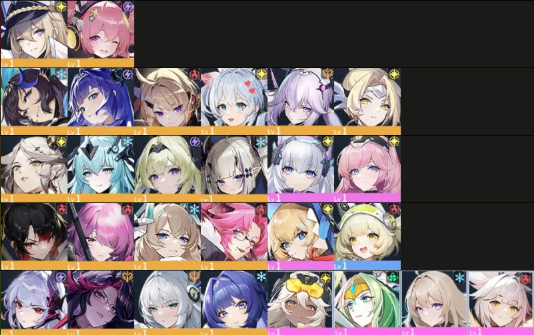
Our tier list is structured based on group consensus pulled from multiple meta resources and player data:
Tier 0 — Absolute best, meta-defining Operators,
Tier 0.5 — Very strong elemental cores,
Tier 1 — Core DPS/support based on elements,
Tier 2 — Strong early game picks,
Tier 3 — Mediocre and low-priority Operators.
II. TIER 0 – STRONGEST CHARACTERS
A. Overview of Tier 0 Mechanics
Tier 0 Operators excel in both PvE and PvP. They aren’t just strong — they bring utility, synergy, and long-term relevance. These are often your go-to picks for team anchors (pun intended).
B. Tier 0 Characters Overview
1. **Karanissa — Lightning DPS
Karanissa sits at the top because of her massive damage output and chaining mechanics. When she gets a takedown, she can immediately attack another target, making her a lethal force especially in high-damage burst comps. Her Lightning element and Striker role make her a staple DPS in most teams.
2. **Tern — Quantum Support/Buffer
Tern is one of the best support Operators thanks to her buffs that stack offensive potential across your team. In many team builds, she boosts damage significantly — and her Quantum element gives her utility even outside her main role.
3. **Tiya — Quantum DPS
Tiya stands out for her consistent Quantum damage and utility that scales well with party synergy. She’s less common but wildly effective when you build around her strengths.
4. **Lilira — Quantum Healer
The best healer in Anchor Panic for most meta teams. Lilira doesn’t just heal — she shields and even provides a revive mechanic once per battle when fully ascended. That makes her invaluable in endurance fights.
5. **Echo — Lightning Support
Echo is a top-tier support with damage buffing and battlefield control. She can silence enemies with AoE skills — a massive utility boost in both PvE and PvP.
C. Tier 0 Team Building Strategies
A strong team often pairs a main DPS with complementary supports. A typical Lightning core could be Karanissa + Echo + Ling (for debuff) + Lilira (support), with a Quantum Utility like Tern for stat boosts.
D. When to Invest in Tier 0 Characters
If you roll any of these Operators early, prioritize them in your roster. They speed up story progression, clear high floors in endgame modes, and are generally future-proof for foreseeable patches.
III. TIER 0.5 – VERY STRONG ELEMENTAL CORE CHARACTERS
A. Understanding Tier 0.5 Placement
Tier 0.5 characters are almost as strong as Tier 0 but often need specific team setups or elements to shine fully. They are still worth major investment.
B. Fire Element Team Members
Olivia — strong Fire DPS/support with great AoE potential.
Merlot — notable for handling Burn effects and AoE damage in Fire teams.
C. Lightning Element Team Members
Flicker — solid Lightning hybrid with good support utility.
Ling — great at reducing resistance and pairing with Electric DPS.
D. Ice Element Team Members
Lengjiao — strong Ice CC/DPS, crucial for freeze strategies.
E. Quantum Element Team Members
Alice / Eucaly — versatile Quantum units that mix offense and utility.
F. Physical Element Team Members
These tend to be DPS guys that fill in Physical comps effectively but might lack the burst of higher tiers.
G. Tank & Support Specialists
Dione and Antilope — great SR characters that aren’t OP but are solid and easy to build.
H. Why SR Characters Matter
SR Operators can actually outperform weaker SSRs if you prioritize synergy and role coverage. They’re also easier to upgrade early as F2P or budget players.
IV. TIER 1 – CORE DPS & SUPPORT BASED ON ELEMENTS
Tier 1 characters are standard choices that show good performance across modes but may require elemental synergy or specific builds.
A. Elemental Team Compositions Overview
Tier 1 is sort of the backbone — characters here help round out teams and fill gaps in elemental synergy. They’re not as dominant as Tier 0, but they’re very solid picks.
B. Fire Element Specialists
Characters who shine in Fire DPS or support roles with elemental buffs.
C. Lightning Element Specialists
Great partners for Electric teams with complementary skills.
D. Ice Element Specialists
Include CC abilities and unique crowd control utilities.
E. Physical Element Specialists
More traditional damage dealers or flexible units.
F. Quantum Element Specialists
Reliable damage and support options that boost team performance.
G. Natural Element Specialists
Less common but still useful in niche builds.
V. TIER 2 – STRONG EARLY GAME CHARACTERS
Tier 2 is a solid pool of characters who excel early but typically get overshadowed later by stronger comps. They’re perfect for new players to progress without major resources.
A. Overview of Tier 2 Viability
These Operators tend to have decent skills and synergy but lack the top-end power for harder content.
B. Early Game Powerhouses
Operators like Neon and Prism fit here — they’re great until you get Tier 1 or Tier 0 picks.
C. Best R Characters
Rarity doesn’t always mean bad — R characters can fill roles temporarily while you wait for better pulls.
D. When to Replace Tier 2 Characters
Once you draw a Tier 1 or higher unit, consider retiring Tier 2 in favor of the stronger option.
E. Tier 2 Progression Tips
These characters are great for grinding up to mid-game content and learning mechanics.
VI. TIER 3 – MEDIOCRE & LOW-PRIORITY CHARACTERS
Characters here are generally underwhelming and often outperformed by others in every situation.
A. Why Tier 3 Characters Rank Low
They might lack impactful skills, synergy, or scaling compared to their peers.
B. Tier 3 Character Breakdown
Includes units like Alicia, Trigger, Corrosicat, Arc, and Core — fine for early stages but quickly outclassed.
C. When Tier 3 Characters Might Be Useful
In niche builds or early progression before you get better Operators.
D. Resource Management: When to Skip Tier 3
Don’t waste ascension or sigil resources on these if you can avoid it — they provide low return on investment.
Continue with next parts if you want elemental comps, beginner recommendations, PvE/PvP metas, reroll strategy, ascension guides, FAQ, and more deep insights tailored for long-term Anchor Panic progression. Just let me know and I’ll build the full expanded guide!