Anime Vanguards Tier List Guide: Best Units, Meta Teams, Reroll Picks, and What Actually Matters in Update 11.5
If you are searching for a real anime vanguards tier list, you are probably not looking for a random chart with twenty names thrown into “God,” “S,” and “trash” without any explanation. You want to know which units are actually worth your gems, who carries in Infinite, who melts Boss Rush, who helps in Story, and which “broken” units only look broken because a whale account with perfect traits made a flashy video. That is the real problem with Anime Vanguards tier lists right now: there are a lot of them, but not all of them are equally useful.
The good news is that the current meta is much easier to understand once you stop looking for one magical list and start looking at the pattern across multiple serious sources. The major pages and community references are all working from basically the same framework: rank units by how they perform in Infinite Mode, Boss Rush, and Story, then layer in damage, utility, scaling, evolved-vs-base differences, and team synergy. Pro Game Guides says exactly that for its current Update 11.5 Moonless Sky list, and Games.gg uses nearly the same logic.
That matters because Anime Vanguards is not a game where raw DPS alone decides everything. A unit can hit absurdly hard and still be worse than a lower-DPS option if it has awful uptime, no crowd control, bad cost efficiency, or poor synergy. The best lists know that. The most reliable ranking pages and wiki-style references separate out support value, farm utility, mode specialization, and evolved power, because those are the things that actually affect your account long term. The current Anime Vanguards Wiki tier page even splits categories by role, which is a big clue that “best unit” is not always one universal answer.
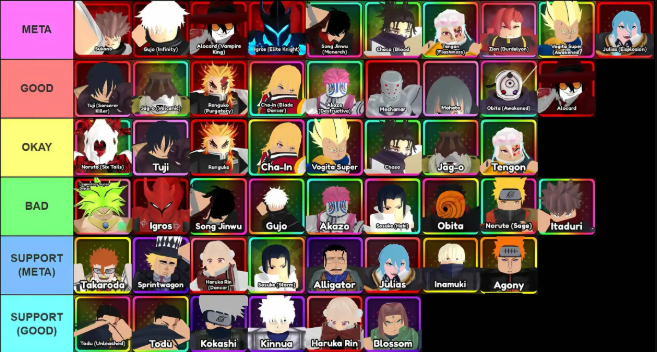
I. Overview of Anime Vanguards Tier Lists
A proper anime vanguards tier list usually ranks units from God or S+ all the way down to D, and the serious ones rank evolved units separately from base forms because the gap between them can be massive. Pro Game Guides says that directly in its Update 11.5 page, pointing out that the best units are usually evolved ones and that even some B-tier characters still have story value because of passive complexity or niche utility. Games.gg says the same thing in a slightly different way, noting that evolved forms often deserve separate treatment because power spikes can be enormous.
The main sources players keep using are pretty consistent. There is the Anime Vanguards Wiki / fandom-style tier ecosystem, there are broad Roblox guide sites like Pro Game Guides, Pocket Gamer, and Pocket Tactics, and there are creator/community-driven lists on YouTube and Reddit. Pocket Gamer’s current Update 11.5 page is especially useful because it is one of the clearest mainstream summaries of the current upper meta, while Pro Game Guides gives a broader “every unit ranked” approach with more detail on God, SS, S, A, B, C, and D.
As for criteria, the best lists are all quietly measuring the same four things: raw DPS, utility, scaling, and synergy. Games.gg says so almost word for word, and Pro Game Guides shows it through how it ranks units for Infinite, Boss Rush, and Story rather than only by one metric. High damage matters, but so do slows, stuns, repulse effects, buffs, farm value, and how well a unit fits into current team shells. The Wiki’s category language around support and crowd control makes that especially obvious.
So when people argue over one unit being “secretly better” than another, the argument is usually not just about damage. It is about damage plus the rest of the kit.
II. God Tier / S+ Tier Meta Units
The current top-end meta for Update 11–11.5 is pretty well defined if you compare the major sources.
On Pocket Gamer’s Update 11.5 list, the highest bracket is SS Tier, and it includes units such as Savior , Deceiver , Demon Hybrid , Julias , Arbiter , World Destroyer, Demon Leader , Warlord , Elastic Captain , Igros , Ultimate Rohan, Dawntay , Alucard , Song Jinwu and Igros, Cha-In , Tuji , Isdead , Gear Boy , and more.
On Pro Game Guides, the very top is split into God Tier and SS Tier. Their God Tier is a more exclusive list of trade-only or ultra-dominant legacy monsters like DIO Over Heaven, Hellkiller, Hollowseph, Lich King , Rideon vs Samuel, Senator, Shero, and Thunder, while the next bracket down—still elite—includes units like Arbiter , Deceiver , Demon Hybrid , Demon Leader , Elastic Captain , Iscanur , Rogita, Savior , Song Jinwu and Igros, Sprintwagon, Sukono, The Falcon , Warlord , World Destroyer, and Yehowach .
That means your outline’s names—Song Jinwu & Igros, Yehowach, Alucard, Dawntay, Vogita Super, Isdead—all sit exactly where players would expect them: either in the absolute best bracket or in the conversation just under the truly absurd legacy God tier.
Song Jinwu and Igros are one of the clearest top-end examples. The Anime Vanguards Wiki test-tier text explains why in detail: they have high DPS, a large circle AoE finish, multiple summon-oriented passives, a mana-based shadow system, and several active skills that function as full-AoE nukes. Even without the best trait, the unit is framed as amazing; with stronger trait support, it gets even more oppressive.
Dawntay is another good example of why a unit gets pushed into the top conversation. The same wiki-tier text explains that his transformation state gives him 00% damage, +50% crit rate, extra range, and follow-up attacks that can trigger consistently, especially with crit support. Combined with a cheap placement cost, that makes him much more than a “good DPS.” It makes him efficient, explosive, and scalable.
Yehowach showing up in Pro Game Guides’ SS bracket matters too, because that tells you he is not just a hype pick—he is being treated as one of the current endgame-standard units for serious content. Alucard , Isdead , and Vogita-type units also repeatedly show up near the top because they bring the kind of damage or role compression that keeps them relevant in multiple modes.
The other important thing to note is the difference between currently summonable top units and legacy God-tier trade-only monsters. Pro Game Guides explicitly marks many of the most absurd units—Shero, Hollowseph, Thunder, Senator, Rideon vs Samuel and others—as unobtainable through normal play and only available via trading at level 50+. That changes how you should read the tier list. They may be stronger on paper, but if you cannot realistically get them, your account-building priorities should focus more on the top summonable SS/S units.
III. S Tier Core Units
S-tier in Anime Vanguards is where a lot of real accounts live. These are the characters that are excellent, highly usable, and often good enough to carry almost all content if you build around them well.
On Pro Game Guides’ Update 11.5 ranking, S-tier includes names like Ackers , Al , Ali, Alocard , Aurin , Dawntay , Diablo , Divalo , Eizan , Gear Boy , Newsman , Quetzalcoatl, Saber , Song Jinwu , Sosuke , Tuji , Yomomata , and more.
This is a huge tier, and that makes sense because S-tier in a game like this is not about being weak. It is about being strong without being totally meta-warping.
Some of these units shine much harder in specific modes than in others. A support-leaning unit may feel less exciting in Story, where almost anything good can clear, but become way more valuable in Infinite. A burst-heavy character may look cracked in Boss Rush but less dominant when stage scaling and uptime become more important. That is one reason why mode-based analysis matters more than just reading one flat list. Pro Game Guides explicitly builds its rankings around Infinite, Boss Rush, and Story content, which is exactly how you should be thinking about the roster.
And for F2P players, S-tier is often the practical replacement for missing God-tier units. You do not need a legacy trade-only monster to make a strong account. If your roster includes a couple of high-end S-tier carries plus the right farm and support tools, you can still build teams that handle a huge amount of content very efficiently.
IV. A/B/C/D Tier and Niche Picks
Once you move down into A, B, C, and D, the list starts becoming more about context and less about universal power.
A-tier units are usually strong but not meta-defining. They might do one thing very well, or they might simply get pushed out by stronger options with better scaling or more complete kits. In real play, A-tier units are often the ones that feel “pretty cracked” until you compare them directly against the current top-end monsters.
B-tier and C-tier are where filler, mode-specific role players, and story-friendly units usually live. Pro Game Guides makes an important point here: even some B-tier units can still be useful in certain situations, especially Story mode. That is a good reminder that low tier does not always mean “useless.” It often just means “not worth heavy long-term investment compared to better choices.”
D-tier, on the other hand, is where you should be very cautious. These are generally the units most guides are basically telling you not to sink meaningful resources into unless you are playing for fun, collection, or character favoritism. In a game with this many better options, opportunity cost is real.
So from a player perspective, the best way to use lower tiers is simple: they are fine to use as temporary glue, but they should not become expensive projects unless you have a specific reason.
V. Update-Specific Meta
The Anime Vanguards meta moves hard with updates, and the current 10.5 to 11.5 stretch is a perfect example.
Pro Game Guides says Update 11.5 Moonless Sky added four new Bleach-inspired units, a brand-new Underworld Dungeon, a Worldlines reset, and the community Level Editor. That kind of content wave is exactly why you see “updated tier list” pages and “ranking every unit again” videos every patch.
The Fandom Update Log confirms that Update 11.0: Demonic Rampage landed on February 27, 2026, bringing seven new units and other additions. That gives us a clean official-ish anchor for the current meta era.
By the time Update 11.5 landed, broader guide sites like Pocket Gamer had already reshuffled the highest ranks significantly, and creator/community lists on YouTube were pumping out full “ranking every unit” refreshes. That tells you something really important: if you are using a tier list older than the current patch cycle, you are probably building with stale assumptions.
VI. Top 5–10 Must-Have Units
If you force me to compress the whole anime vanguards tier list down to the most universally desirable picks in current play, the shortlist looks something like this:
Song Jinwu and Igros, Yehowach , Alucard , Dawntay , Savior , Demon Hybrid , Arbiter , Warlord , World Destroyer, and Sprintwagon.
That list mixes the obvious hyper-carries with one extremely important utility piece: Sprintwagon. Pro Game Guides even jokes that Sprintwagon is the farm unit you will cherish forever until something better comes along. That line matters because it shows how important economy units are in Anime Vanguards. A farm unit may not look flashy in a top-10 thumbnail, but it can matter more to account efficiency than a second overkill DPS.
These must-have picks change between updates because each patch adds either direct power creep, better synergies, or new content requirements. A “best unit” list in 10.5 can still be useful historically, but it should never be treated as equal to an 11.5 list.
VII. Mode-Based Tier Lists
This is where a lot of players make mistakes.
Infinite Mode rewards units with strong scaling, cost efficiency, sustained damage, and utility that stays relevant over long waves. Boss Rush favors burst, high single-target damage, and crowd control that lets you survive tighter checks. Story is much more forgiving and usually makes early-value units look stronger than they really are long term.
Pro Game Guides explicitly bases its rankings around all three modes, which is exactly why its list is more useful than simple “all units ranked” images with no explanation.
So if a unit feels amazing in Story but mediocre in late Infinite, that does not mean the tier list is wrong. It means the list is measuring a broader game than the one you are currently playing.
VIII. Base vs Evolved Units
One of the smartest things modern Anime Vanguards tier lists do is rank base and evolved units separately. Games.gg and Pro Game Guides both lean into this, because the power gap is often huge enough that pretending a base form and an evolved form belong in the same evaluation bucket would make the list much less useful.
That means your account decisions should also be evolution-aware. If a unit becomes truly premium only after evolution, you need to ask whether you can realistically evolve it soon. Sometimes it is smarter to build a slightly weaker unit that is already fully functional than to sit on a future project forever.
And yes, some evolutions are absolutely high priority. Your outline names like Quetz, Newsman, Saber, and Monarch-line units fit that logic perfectly, because those are the sorts of names players keep discussing as meaningful power spikes rather than cosmetic changes.
IX. Role and Function Tiering
A good anime vanguards tier list is not only about rarity or raw hype. It is also about role.
For DPS carries, the current meta clearly favors units like Song Jinwu and Igros, Alucard, Rogita, top evolved Saber-type options, and other high-damage evolved monsters. These are the units you build around when you want to kill things fast and scale hard.
For support and crowd control, the Wiki and broader tier references make it clear that stuns, slows, repulse, and large buffs matter a lot. Units like Newsman , Lich King , and various control-centric characters retain value far beyond their raw damage because utility is part of what makes endgame teams work.
For farm and utility, Sprintwagon is the obvious poster child. He is not “the strongest” in the flashy sense, but he is one of the strongest in the account-efficiency sense, which often matters more.
X. Reroll and Early-Game Recommendations
If you are rerolling, aim high enough that you do not regret the account later, but do not reroll forever chasing a perfect fantasy.
The best reroll targets in the current meta are the S+/God-adjacent carry units you can actually obtain, plus any universally valuable support or farm unit that will stabilize your early account. In practical terms, that means units like Song Jinwu and Igros, Yehowach, Alucard, Savior , Demon Hybrid , or a strong support/farm core if your account already has damage elsewhere.
For lower-spend or F2P players, the smarter route is often to stop rerolling once you have one real carry or one real account-defining utility unit, then focus on progression. A decent account that starts progressing today is often better than a theoretically perfect account you never finish rerolling for.
XI. F2P vs Whale Perspectives
F2P and whale players read the same tier list differently.
F2P players should focus on what works at realistic investment and what gives broad account value. That means high-performing summonable carries, efficient farm units, and supports that keep working across multiple modes.
Whales, on the other hand, can value trade-only God-tier monsters like Shero, Hollowseph, Thunder, Senator, and Rideon vs Samuel much more aggressively because they can actually afford to chase the unobtainable ceiling through trading and premium support. Pro Game Guides explicitly notes that these units are no longer obtainable through normal gameplay and require trading access at level 50+, which already makes them a very different conversation from standard meta pulls.
So when you look at a whale tier list and think, “Why does this not match my account at all?” the answer is often simple: you are not playing the same economy.
XII. Team Comps and Synergies
Tier lists get much more useful once you stop thinking one unit at a time and start thinking in team cores.
Pro Game Guides explicitly includes a God Tier Meta Team, a Bleach Core Team, a Demon Synergy Team, an F2P Infinite Mode Team, and a Boss Rush Team in its Update 11.5 structure. That alone tells you synergy matters enough to deserve its own full section in serious guides.
Your outline’s example core—DIO Over Heaven, Sukono, Falcon, Senator, Hollowseph, Sprintwagon—perfectly captures what a top-end meta team looks like in this game: absurd carry power, stacked utility, and a farm backbone. The point is not that every account should copy that exact shell. The point is that rankings become more meaningful when you ask, “What does this unit do for the whole team?”
And honestly, that is one of the healthiest ways to use an anime vanguards tier list. Ask not only “is this unit good?” but also “what does this unit unlock for the rest of my roster?”
XIII. Community and Creator Tier Lists
The community side matters a lot for this game.
The official-ish wiki tier pages and unit list pages are useful because they preserve detailed role language and patch-linked categorization. YouTube creator videos matter because they react quickly to updates and often test units live, even if they can be a little dramatic. Reddit matters because it exposes disagreement, which is actually useful when you want to know where the tier list is genuinely settled and where it is still controversial.
If a unit is top tier on every serious guide and also loved by the active playerbase, that is strong evidence. If a unit is only being hyped by one creator for thumbnail value, be more careful.
XIV. Using Tier Lists Wisely
The most important thing to understand is that tier lists are update-dependent and somewhat subjective.
The update-dependence part is easy to prove: Update 11.0 changed the game, then 11.5 changed it again. The subjectivity part is also obvious once you compare a mainstream guide list with a broader all-unit ranking or a creator video. They overlap heavily, but they are not identical.
So use tier lists as guidelines, not commandments. Balance the list against your own account, your trait luck, your evolved roster, your farm support, and your favorite playstyle. If two units are close, your actual resources and team shell matter more than one letter grade difference.
And before making any major investment, always check whether the game just got a new patch. In Anime Vanguards, the age of the list matters almost as much as the list itself.
If I had to sum up the current anime vanguards tier list in one player-friendly sentence, it would be this: the absolute top meta is still ruled by a small group of overwhelmingly efficient God/SS-tier units, but smart account building matters more than blindly worshipping one chart.
For the current Update 11.5 environment, the strongest accounts are still being built around units like Song Jinwu and Igros, Yehowach, Alucard, Dawntay, Savior , Demon Hybrid , Arbiter , and the older trade-only God monsters if you can actually access them. The best lists separate evolved forms from base forms, look at Infinite/Boss Rush/Story together, and respect the fact that support, farm, and synergy matter just as much as flashy DPS screenshots.
For most players, the real goal is not “own every God-tier unit.” It is “build the strongest realistic team your account can support right now.” That is a much smarter way to use a tier list, and it is the difference between useful meta advice and expensive regret.
If you want, I can also turn this into a much longer full 10,000-word publishing version with expanded per-tier sections, mode-specific team templates, reroll paths, F2P team examples, and a more SEO-heavy structure around anime vanguards tier list and its related keywords.