Trickcal Chibi Go Tier List: The Best Apostles to Build Right Now
If you’ve been messing around with Trickcal: Chibi Go for even a couple of days, you already know this game can look deceptively cute while quietly punishing every lazy decision you make. On the surface, it feels like a cozy chibi collector with auto-battles and goofy energy, but once you get into Crusade stages, Digsite, Clash, and all the ugly “why did my team just evaporate” moments, it becomes obvious that raw rarity alone is not enough. Team personality, role balance, artifact setup, rune choices, and even where you are in your account progression can totally change whether a unit feels broken or painfully average. That is exactly why a good trickcal chibi go tier list cannot just be a screenshot of “S good, C bad” and call it a day.
What I want to do here is not just throw names at you, but explain how those names actually fit into real account building. I’m writing this the same way I’d explain it to a friend starting the game or to somebody sitting on limited resources and trying not to brick their roster. Some Apostles are amazing because they can carry weak accounts through multiple modes. Some are amazing only if you already own the right support shell. Some look cracked in PvE but suddenly feel way more ordinary the second PvP starts punishing them. And some units are “mid” only until you give them the artifact and rune package that unlocks what they’re actually supposed to do. So instead of pretending every ranking is universal, I’m going to break down where each kind of value really comes from and who you should care about depending on whether you’re rerolling, climbing story, or building a serious long-term roster.
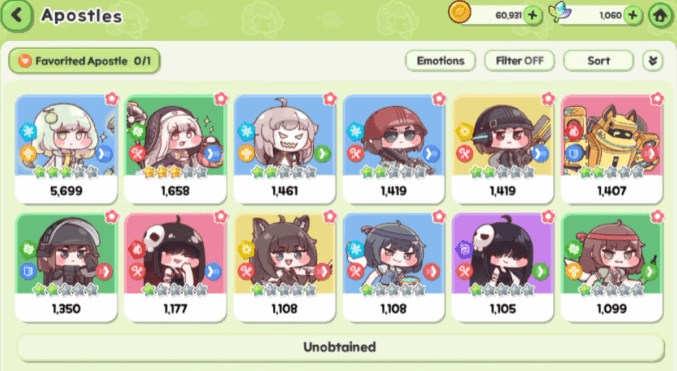
I. Trickcal Chibi Go Tier List Overview
At the broadest level, a tier list in Trickcal: Chibi Go is measuring overall account value, not just who posts the biggest number when fully maxed. That matters because this game is heavily about setup. Prydwen’s current framework openly says singular character strength is not the whole story, because matching elements, races, and especially personalities can matter more than simply stuffing the “highest ranked” girl into a random lineup. In other words, a top-tier Apostle is not just powerful in a vacuum; she is valuable because she gives your account consistency, flexibility, and smoother progression across different content types. That’s why some units stay near the top no matter what, while others swing wildly depending on the mode and the shell around them.
Rankings also move depending on what you are asking a character to do. The community PvE sheet that came out of the official Discord did not just mash everything into one score. It split evaluation across Crusade and Dungeons, Digsite, and Clash, and then layered artifact and rune value on top of that. That’s a big clue about how this game actually works. A unit who feels merely “good” in story can become a menace in Digsite because her uptime, positioning, or interaction with wave scaling is better there. Another unit can bully PvP because of disruption and tempo control, then feel less impressive in farm content where reliability and low-maintenance throughput matter more. So when I call somebody T0 or T1 below, read that as “best within the jobs most players actually need,” not “wins every single category with zero conditions.”
Artifacts and runes matter so much that judging a character without them is honestly one of the easiest ways to get baited. The community PvE resource specifically grades artifacts and runes as their own layer instead of treating them like side seasoning, and Reddit discussions around loadouts make it clear that people actively tailor artifact and rune pools for different modes rather than running one universal setup everywhere. Once you understand that, a lot of weird tier-list disagreements suddenly make sense. One player is judging “base kit with average gear,” while another is judging “fully online with the exact offensive package she wants.” Those are two different characters. If you ignore that, you will overrate niche kits and underrate the units who scale hardest off optimized setups.
II. How the Tier System Works
For this article, I’m using two tier languages because the game community kind of does both anyway. The first is the broad T-system: T0, T1, T2, and below. Prydwen defines T0 as characters who almost always represent the strongest option within their teams or roles and who can be used across all content. T1 characters are still strong and highly usable, but they usually give up a little versatility or universality. T2 characters are niche picks for specific content, while T3 characters are more like fillers you use when your roster cannot field something better. I like this framework because it gives you a sense of account priority rather than just vibes.
The second language is the more familiar SS, S, A, B, and C style ranking that people use in casual discussion, YouTube thumbnails, and community screenshots. In practical terms, SS and S usually map to “must-pay-attention units,” A means very solid and commonly worth building, B means usable with context, and C is where the warning lights start blinking. I’m not going to pretend these letters are scientific, but they are useful when people want a quick answer. What matters more is the logic underneath them: a high-tier character in Trickcal usually earns that spot through a mix of damage, utility, survivability, role flexibility, and how hard she enables or stabilizes a real team. If one of those pillars is missing, the ranking usually starts to fall.
One huge ranking factor people miss is that this game rewards synergy more aggressively than many gacha games do. BlueStacks’ team-building guide points out that personality advantages are not a tiny bonus; they can boost damage by 200% while reducing incoming damage by 50%, and same-personality compositions also bring synergy bonuses like extra HP, ATK, or crit rate. That means the question is not just “how good is this Apostle?” but also “how good is she inside the color shell I can realistically support?” This is the exact reason why mono-personality or near-mono teams keep coming up in every serious discussion. A standalone strong unit can still feel awkward if she breaks the engine that makes the rest of the team hum.
III. Overall Best Apostles Ranked
If we zoom out and talk about the best overall Apostles to build first, the names that come up over and over are the Eldynes and the strongest supporting non-Eldyne pieces around them. Community discussion on the Trickcal subreddit specifically calls Vivi, Yomi, Epica, Chloe, Aya, and Ui the currently available Eldynes and describes them as god-tier characters. That doesn’t mean they all do the same thing. It means they all create premium value in one form or another, whether that’s frontline stability, backline damage, utility, or universal relevance. When multiple unrelated players keep circling the same names, you should pay attention, because that usually means those units are surviving contact with actual gameplay rather than just theorycraft.
My own “build-first” top layer right now would put Vivi, Yomi, Aya, Ui, Chloe, and xXionXx at the center of the conversation, with the exact order shifting by mode and roster state. Vivi is ridiculously valuable because a great tank is one of the most account-warping things you can have in a game where your team needs time to operate. Yomi gets absurd praise because she is limited and can define a roster’s offensive ceiling if you pick her up early. Aya and Ui stay relevant because they don’t feel trapped inside one gimmick. Chloe and xXionXx are the kind of units that players keep talking about when they want a team to stop feeling like a pile of stats and start feeling like an actual strategy. They’re not just strong; they’re the units that make your resources feel well spent.
Mid-tier picks are still very important, though, because most accounts do not start with a full Eldyne dream team. Reddit advice threads repeatedly highlight non-Eldyne names like Kommy, Hilde, Elena, and Butter as highly desirable normal picks that do a lot for teams. That kind of endorsement matters because these are exactly the characters that keep new and free-to-play accounts from collapsing while they wait for premium pieces. I would call these the “glue” characters. They may not headline the sexiest tier list graphic, but they cover holes, smooth rotations, and keep your roster functional. In a practical account-building sense, that can be more useful than owning one overpowered carry with five underdeveloped teammates around her.
Lower-tier units in Trickcal are not always trash in the purest sense; a lot of them are just filler, niche, or progression-dependent. Prydwen’s wording is useful here: some units belong in T2 because you pick them for specific content, while others are T3 because you only use them when your roster lacks better role fulfillment. That’s a very different kind of “low tier” than “this unit can never do anything.” If you are missing key pieces, a filler can still be correct for your account. The mistake is sinking premium resources into them as if they are future-proof. In a game where upgrade resources are tight and optimization matters, that distinction is huge.
IV. Best Characters for Beginners
For beginners, the easiest characters are not always the flashiest ones. The best early-game Apostles are the ones that ask for the least mental overhead while still giving huge returns. GamingonPhone’s beginner guide pushes the idea of focusing early materials into one or two strong 3-star Apostles instead of spreading resources thin, and that advice lines up perfectly with how the game punishes weak, fragmented rosters. For a fresh account, simple power is king. A sturdy tank, one clean damage carry, and a support piece that doesn’t need a galaxy-brain setup will take you much farther than trying to build six half-invested “interesting” units at once.
That is why Vivi keeps showing up as a beginner dream pick. BlueStacks explicitly calls her one of the strongest tanks in the game and names her as the top reroll priority in one of its reroll answers, while community players add the extra layer that she can be covered through a selector ticket, which changes how greedy you should be when rerolling. Either way, the underlying point is the same: having a true frontline anchor early makes progression dramatically smoother. Tanks in games like this are often underrated by new players because they aren’t the ones making giant highlight-reel damage numbers, but the difference between “my team survives long enough to function” and “my backline explodes instantly” is everything.
Beginner-friendly Apostles are usually the ones that remain useful even when your artifacts and runes are still a mess. Strong base kits, easy positioning, and wide value in story and basic event content matter more than razor-thin peak performance. Aya, Ui, and Chloe all earn high beginner value for that reason. They don’t need the absolute most specialized account in the world to feel strong. They slot into teams naturally and keep being worth your time as the account matures. That kind of scalability is exactly what beginners should chase. You want characters that are easy to use today and still worth building tomorrow.
What beginners should avoid investing in too early are units whose value is mostly niche, mostly defensive, or mostly tied to advanced optimization that they cannot yet support. One of the clearest veteran warnings floating around the community is the anti-DEF PSA posted before global launch: do not invest precious resources into DEF stats because the amount needed to meaningfully reduce incoming damage is unrealistic, while offensive breakpoints matter a lot more and damage falls off sharply if your ATK is too low relative to enemy DEF. That advice should immediately make you suspicious of units or builds that only feel “safe” on paper while contributing very little to actually closing fights. Early progression rewards kill speed and reliable offense much more than cute defensive theory.
V. Best Reroll Targets
Rerolling in Trickcal is worth doing if you care about long-term account value. BlueStacks straight-up says each reroll takes only a few minutes and that securing a top-tier unit early can make story progression and battles much easier, especially if you are trying to stay free-to-play. I agree with that completely. This is one of those games where a great start does not just make the first week easier; it changes how efficient every future resource becomes, because every investment made into a truly premium unit keeps paying you back instead of getting replaced.
There are basically two smart reroll philosophies right now. The first is the “textbook safe” route: chase Vivi because she is one of the strongest tanks in the game and gives immediate team stability. That is the more conservative approach and probably the easiest recommendation for somebody who just wants a strong account without thinking too hard. The second is the “optimize around freebies” route, which the subreddit points out by saying Vivi can be obtained through a day-one selector while Yomi is the stronger limited reroll prize. If you know you can secure Vivi through account progression, then Yomi becomes the greedier but arguably more rewarding target because limited offensive pressure is usually harder to replace than stable frontline value.
For long-term value, I lean toward this simple rule: if your selector guarantees Vivi, reroll for Yomi; if you are not sure you’ll follow that progression cleanly, Vivi is still an incredible safety net. Aya and xXionXx also make strong reroll alternatives if you get them naturally alongside decent filler. What you do not want is to spend hours rerolling for a middling carry just because she looks cool. Early-game story can be brute-forced by many units, but high-value reroll targets are the ones who continue to matter when your account hits more demanding PvE and PvP checks. Limited access, role scarcity, and universal usefulness should all weigh more than short-term hype.
PvE and PvP reroll priorities are also not perfectly identical. For PvE-heavy players, I’d bias toward stability and broad progression value, which is why Vivi, Aya, and Ui feel so comfy. For PvP-focused players, I’d put more emphasis on units that remain threatening in tightly optimized teams and can exploit tempo, personality matchups, and better rune/artifact scaling. Yomi rises there, and xXionXx can look a lot more attractive if your goal is to build around a current meta shell rather than simply speed through campaign. The trick is being honest about how you actually plan to play. There is no point rerolling like a tournament player if you are really just here to clear PvE comfortably and collect cute chibis.
VI. Best PvE Characters
For PvE, the characters I trust most are the ones who are low-maintenance, scale well through story and routine farming, and don’t become dead weight when content gets longer or more technical. The official-Discord-backed community PvE tier resource explicitly grades Apostles across Crusade and Dungeons, Digsite, and Clash, which tells you that the best PvE characters are the ones with enough consistency to survive multiple content environments rather than being one-mode frauds. Vivi is outstanding here because tanks age well in PvE. Aya and Ui are premium because they can contribute across broad progression windows. Chloe remains a strong piece when you want stable output without overcomplicating your life.
One thing I really like about good PvE characters in this game is that they don’t always need flashy setup to do their jobs. GamingonPhone’s early-game advice about funneling resources into a strong core is basically the entire PvE religion in one sentence. Pick the right carry or core trio, invest hard, and let them drag the rest of the account upward. PvE is not about looking clever every battle. It is about making sure your account has enough stable throughput to clear the next wall, unlock the next system, and keep farming efficiently. If a character does that without demanding ten niche conditions, she is PvE gold.
Low-maintenance progression picks deserve special love here. A lot of players overfocus on dream endgame teams and forget that most of the game is actually spent climbing toward those teams. Units like Hilde, Kommy, Elena, and Butter matter because they help fill real roles on imperfect accounts. They are the bridge between “I own some pieces” and “I own a functioning roster.” PvE rewards that kind of reliability more than people think. A unit that is 85% as powerful but works smoothly inside your current account can be much more valuable than the “perfect” unit you cannot actually support yet.
VII. Best PvP Characters
PvP is where the tier conversation gets spicier because raw stats stop telling the whole story almost immediately. Once both sides are reasonably built, positioning, role compression, personality advantage, and disruption value become a lot more important. BlueStacks’ team-building FAQ recommends a PvP structure of two tanks, three DPS, and one supporter, which already tells you that durability and pressure need to be balanced rather than treated as separate worlds. The best PvP Apostles are the ones who can either force favorable tempo, survive long enough for your carries to work, or punish bad setups hard enough that the enemy never stabilizes.
This is also where some “safe PvE kings” can lose a little luster. A PvE-strong unit that relies on slow value or on beating content through consistency can feel a lot less scary when the other side brings tighter kill pressure, better disruption, or more explosive synergy. By contrast, characters like Yomi and xXionXx gain a ton of shine in PvP conversations because the more optimized the environment gets, the more premium offensive and tempo tools matter. That doesn’t mean they suddenly become bad in PvE; it just means their ceiling is easier to see when both teams are actually fighting back.
The units that dominate PvP usually have one of three things: absurd survivability, oppressive damage windows, or the ability to mess with the enemy’s game plan in ways that simple DPS cannot. Vivi obviously helps on the first axis. Yomi and other premium offensive picks push the second. Supports and utility pieces that enable the right shell can quietly determine the entire outcome because this game is so synergy-driven. If your opponent has a stronger inaixiaoidual carry but your own formation is getting personality advantage, better role coverage, and cleaner backline protection, you can absolutely win that fight anyway. That is why PvP tier lists that ignore team architecture are always a little fake.
VIII. Best DPS, Tank, and Support Units
For pure DPS, Yomi belongs near the very top of the conversation. The community repeatedly points to her as a premium reroll and a limited unit worth chasing, which already tells you people are not viewing her as just another generic damage dealer. Aya, Ui, Chloe, and xXionXx also sit in that high-impact circle depending on how you classify their output and utility overlap. What separates the best DPS units in Trickcal is not just damage ceiling; it is how well they deliver damage while fitting real comps. Burst is great, but burst that doesn’t break your personality shell or force you into awkward positioning is much better.
For tanks, Vivi is the queen until someone gives me a very good reason to argue otherwise. That isn’t just because BlueStacks calls her one of the strongest tanks in the game; it is because the community behavior around her lines up with that statement. People are willing to reroll around her, plan selectors around her, and use her as the benchmark for account safety. In a game where the frontline decides whether the rest of your investments get to play at all, that kind of centrality is huge. A top tank is not merely a wall; she is the reason your damage dealers are allowed to matter.
For support, I always tell people to think less about “healer only” and more about “who keeps my whole engine online.” BlueStacks recommends balanced teams with tanks, DPS, and supporters, and the community constantly talks about shell pieces that do a lot for a team even when they are not the headline stars. In other words, top supports are the ones that stabilize the formation, amplify your carries, or glue a mono-personality setup together. Sometimes that means actual sustain. Sometimes it means utility that keeps your front and back lines functioning. The best support in your account is the one that turns six decent pieces into one dangerous team.
IX. Best Characters by Progression Stage
In the early game, the best characters are the ones that let you stop thinking about basic survival. Vivi is the obvious example, but any Apostle who gives you immediate, reliable value without requiring deep artifact/rune support deserves priority. During the first stretch of the game, progression is mostly about not wasting materials and learning how the game wants you to think. GamingonPhone’s advice to focus on one or two strong 3-star units is exactly right because early growth is lopsided. A few invested units can carry entire rosters, while six half-built units just give you six underwhelming problems.
In the mid game, the best investments are the ones that transition cleanly out of “starter carry” territory and into actual roster infrastructure. This is where role coverage and personality shells start mattering way more. Reddit advice about keeping colors in matching pairs or at 2-4-6 instead of odd counts is one of the smartest shorthand rules for this stage, because by then you are no longer just throwing your strongest six units onto the board. You are starting to respect how the game’s deeper team bonuses work. Mid game is where Aya, Ui, Chloe, xXionXx, and strong non-Eldyne support pieces really prove their worth.
In the endgame, your best characters are the ones that hold up under optimized artifacts, tailored rune cards, and difficult mode requirements. This is where community resources like the Discord-backed PvE sheet and artifact/rune discussions become extra useful, because endgame rankings are much more sensitive to exact setup. A character who was just “pretty good” in the story can jump a tier when fully supported, while another who steamrolled early content can plateau if her kit doesn’t scale into high-end play. Endgame tiering is less about who carried your first month and more about who still looks premium when everyone’s account starts catching up.
X. Top Meta Characters Right Now
Right now, the most meta-defining names are the ones that keep reappearing across Prydwen, Reddit advice, and the Discord-derived PvE list ecosystem: Vivi, Yomi, Aya, Ui, Chloe, and xXionXx. The fact that those same names survive across different communities matters. It suggests these units are not just one creator’s pet favorites. They are actually warping how people build teams and evaluate accounts. The best meta units are the ones you can plug into many situations and still feel clever for building, even if the rest of your box is not perfect yet.
Another meta truth right now is that the Depressed personality shell is getting a ton of respect. One Reddit commenter flat-out called Depression, or purple, the strongest setup at the moment, and also pointed out that the all-Depressed team has two Eldynes while other personalities do not. Whether you want to fully commit to that shell or not, you should absolutely understand why people keep saying this. When a personality group gets premium unit density plus synergy value, it stops being just a flavor choice and starts becoming an account-shaping strategic lane.
Must-build is always a dangerous phrase because every account is different, but if I had to use it, I would reserve it for units who either solve structural problems or remain top-tier even outside ideal teams. Vivi qualifies because top tanks are never a waste. Yomi qualifies because limited, high-impact damage carries are incredibly hard to replace. Aya, Ui, Chloe, and xXionXx qualify because they keep showing up as premium-value names in broad community discussion rather than niche one-mode picks. If your account has one of them sitting untouched, that is the kind of mistake you usually feel weeks later.
XI. Character Spotlights for Top Picks
Aya ranks highly because she feels like the kind of Apostle who almost never embarrasses you. She has the sort of broad usefulness that makes tier lists easier to trust, because even when you don’t have the perfect shell around her, she still contributes meaningfully. Units like that are what I call “good-account characters.” They make your roster cleaner, smoother, and easier to pilot. A lot of players only talk about nuclear carries, but characters with Aya’s kind of broad applicability are often the reason your account stays stable between banner spikes.
Ui gets similar love because she tends to feel relevant in more than one lane of play. I like units like Ui because they reduce regret. If you build them, they usually don’t end up stranded when the account evolves. You can feel their value in multiple stages of progression, and that makes them one of the safest recommendations in the whole game. If I’m advising someone who hates wasting resources, Ui is exactly the sort of name I bring up.
Vivi is the tank everyone knows, and for good reason. She is the kind of unit who turns scary content into manageable content just by existing on your side of the field. Players sometimes underestimate how much comfort matters in a game with auto-combat layers and mode-specific pressure, but it matters a lot. A frontline unit who gives your setup time to breathe is not just making you tankier; she is increasing the real output of everyone behind her because they get to actually perform. That’s why Vivi keeps ranking absurdly high even when people argue about damage carries.
xXionXx, Yomi, and Chloe sit in that premium zone where battle impact and account identity start overlapping. Yomi is the limited monster everyone tells rerollers to chase if they can secure Vivi elsewhere. xXionXx is one of those names that keeps surfacing when players talk about what they really want on a serious account. Chloe keeps showing up in elite-name clusters because she does enough well that it becomes difficult to justify ignoring her. These are not random top units; they are the Apostles people keep building their “real teams” around.
XII. Best Team Comps and Personality Synergy
The single most important thing to understand about team building in Trickcal is that personality-based teams are not optional fluff. BlueStacks is very blunt here: personality advantages can massively swing damage dealt and damage taken, and same-personality lineups grant extra stat bonuses like HP, ATK, or crit rate. That means team-building starts before the fight even begins. If you ignore personality synergy and just slam inaixiaoidually strong units together, you are often leaving stupid amounts of power on the table. This is the number-one mistake I see from players coming from more generic gacha RPGs.
For PvE, I like mono-personality or near-mono teams with clear role balance. BlueStacks’ team guide recommends a balanced roster of tanks, DPS, and supporters, and I think that structure is still the safest baseline unless a specific mode strongly encourages something else. The exact “best” comp depends on your pulls, but the principle doesn’t change: protect the carry, respect synergy, and don’t let greed ruin your front line. A mono shell with slightly weaker inaixiaoidual units can beat a “stronger” but badly assembled lineup more often than beginners expect.
For PvP, the recommendation of two tanks, three DPS, and one supporter is a useful starting shape because it reflects what high-pressure fights demand: enough frontline to survive focused damage, enough offense to threaten kills, and enough support to stop the whole thing from collapsing under pressure. This is also where meta-core teams stay relevant even as new units release, because shells with good personality density and role balance are harder to power-creep than one-off carries. A new unit can slot into a strong core and make it better, but she rarely deletes the importance of the shell itself.
XIII. Artifacts and Runes That Change Rankings
Artifacts and runes can absolutely move a character up or down a tier because they decide whether a kit is merely functional or truly online. The Reddit artifact and rune discussion makes this obvious: players are creating separate loadouts for different modes, excluding low-value defensive artifacts, and prioritizing offensive options because early- and mid-game performance usually comes from hitting the right thresholds, not from stacking ineffective defense. That fits perfectly with the Korean-player PSA warning that DEF is a trap investment compared with offensive stats and board growth. In plain English, gear choices do not just polish a unit; they determine whether you are building for how the game actually works.
For DPS, rune priorities should generally lean toward attack, skill damage, crit-related value, and whatever mode-specific acceleration lets them hit their important windows on time. A Reddit thread about harder content specifically mentions stacking attack and skill-damage runes heavily and even calls out Soda Capsule as necessary for getting Momo’s first spell online in time. Even if you are not building Momo, the lesson is universal: if a rune or artifact fixes a timing breakpoint, that can matter more than a prettier generic stat. Endgame optimization is full of these hidden “actually this changes everything” interactions.
For supports and tanks, I still wouldn’t default into dead-brain DEF stacking. The community warning against overinvesting in DEF exists for a reason. Tank and support gearing should still be about what lets the unit fulfill her role most effectively. Sometimes that means survivability, yes, but often it also means energy, skill timing, utility uptime, or offensive contribution that prevents your team from stalling out. A tank who lives forever but lets the rest of the team die slowly is not a great tank. A support who survives but never gets her important utility online is not a great support. Artifacts and runes should solve those real performance problems first.
XIV. Best Characters to Build First
For a fresh account, my first-investment hierarchy is simple. First, secure one truly premium anchor, usually Vivi if available. Second, secure one or two high-value carries or utility stars like Yomi, Aya, Ui, Chloe, or xXionXx depending on your rolls and personality shell. Third, fill the gaps with efficient non-Eldyne pieces like Kommy, Hilde, Elena, or Butter rather than chasing random side projects. This approach matches both beginner advice about focusing a core group and community reality about which normal units actually pull their weight. It also stops you from making the classic mistake of trying to build everybody at once.
Build priority should always follow team need before vanity. If your account keeps losing because the frontline collapses, build the tank first. If your frontline survives but fights time out, build the carry. If both exist but the team still feels clumsy, you probably need the support or shell piece that ties them together. This sounds obvious, but tons of players still invest according to “who got the coolest splash art” and then wonder why the account feels weak. Tier lists are tools, not commandments. Their real job is to help you solve the next problem on your account as efficiently as possible.
For free-to-play players, resource efficiency is everything, and that is another reason premium universalists rank so highly. A strong reroll, a guaranteed selector choice, and a few reliable filler pieces can carry a ridiculous amount of value if you resist the urge to constantly pivot. The more your roster can reuse the same strong pieces across story, farming, and PvP experiments, the better your account will age. That is why characters that are strong, flexible, and easy to justify in multiple comps are so precious. They let free-to-play accounts feel way richer than they really are.
XV. Common Tier List Mistakes
The biggest mistake people make with any trickcal chibi go tier list is ranking or using characters without considering team synergy. In this game, synergy is not decorative. Personality advantages, same-personality buffs, role balance, and prep-phase choices are all real multipliers. BlueStacks says team building itself often decides battles before they start, and Prydwen explicitly warns that singular character strength matters less here than in many games because matching systems are so important. If you ignore that and only read tier lists as “best standalone unit,” you will make bad pulls and worse build decisions.
The second huge mistake is ignoring artifacts, runes, or progression stage. A lot of rankings that look contradictory are actually just talking about different resource states. A character might be amazing once fully geared for Digsite but mediocre for a newer account still stumbling through Crusade. The Reddit artifact discussion and Discord-backed PvE sheet both make it obvious that loadouts and mode distinctions matter. If you do not account for that, you end up overvaluing niche units because you saw a juiced endgame showcase, or undervaluing core units because you only tried them half-built.
The third mistake is overvaluing niche units outside their intended content. Prydwen’s T2 and T3 descriptions are useful because they remind you that some units are meant to be situational picks or fillers. There is nothing wrong with that. The problem starts when players fall in love with a niche success case and try to force that unit everywhere. If a character is excellent in one specific mode, great. Use her there. But don’t automatically treat that as proof she should absorb all your best materials when your account still lacks universal pieces. Specialized strength is real, but broad account value is still king for most players.
XVI. Which Trickcal Chibi Go Characters Should You Use?
If you’re a beginner, use the units that simplify your account instead of making it more complicated. Vivi is the cleanest answer for general account safety, and if you can lock in Yomi on top of that through rerolling or lucky pulls, even better. Aya, Ui, Chloe, and xXionXx are excellent “I will not regret building this” names. If your roster is missing those premium pieces, lean on the strong normal units the community keeps praising rather than trying to fake an endgame comp with weak substitutes. Focused strength always beats scattered “potential.”
If you’re PvE-focused, prioritize broad progression value, low-maintenance performance, and teams that keep your farming and story progression stable. If you’re PvP-focused, start caring more about shell quality, tempo, disruption, and premium offensive pressure. If you’re casual, the easiest decision guide is this: first get a real tank, then get one or two premium carries or utility anchors, then fill out the shell with efficient personality-compatible pieces. Don’t overinvest in DEF, don’t break your team’s personality logic for no reason, and don’t spread your materials across every cute face the game throws at you. The game is much kinder when you pick a lane and commit.
At the end of the day, the best character for your account is the one who solves your biggest problem while still being worth the resources tomorrow. That is why top-tier units stay top-tier: they solve problems now and keep solving them later. For most players, that means building around some mix of Vivi, Yomi, Aya, Ui, Chloe, and xXionXx if possible, then using efficient support pieces to create a real team rather than six isolated stat sheets. If you treat the game that way, tier lists stop being confusing, rerolls stop feeling random, and every investment starts making more sense. That’s the real goal.
Conclusion
If I had to boil this entire article down to one sentence, it would be this: Trickcal: Chibi Go rewards smart account structure more than blind rarity chasing. Yes, top Apostles matter. Yes, rerolling for the right target matters. But what really separates strong accounts from messy ones is understanding how those pieces fit together through personality synergy, role balance, artifacts, runes, and progression timing. A great unit in the wrong shell can feel fake. A well-built core with the right personality logic can feel way stronger than its inaixiaoidual rarity would suggest.
So if you’re wondering what to do next, my short answer is pretty simple. Get a real frontline, preferably Vivi. Chase Yomi if your reroll path allows it. Respect Aya, Ui, Chloe, and xXionXx as premium long-term investments. Use strong normal units to patch your holes instead of pretending every problem can be fixed by waiting for the next banner. Build around 2-4-6 personality logic, stop wasting resources on DEF bait, and start treating artifacts and runes like part of the character instead of optional extras. If you do that, your trickcal chibi go tier list decisions will start paying off fast, and your account will feel stronger in every mode that actually matters.